Absence Seizures | - Blog Hanz -
Breaking News
recent

Absence Seizures


Petit mal seizure

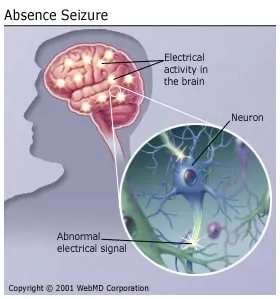
  • This is a form of Epilepsy in which Seizures are caused by abnormal neuronal discharge in the brain -- the "wires" of the brain's electrical circuitry get crossed and discharge abnormally).  Absence seizures are characterized by impairment of consciousness or posture, and usually last only a few seconds.  This type of seizure is more common in those under age 20.

  • Usually begin between ages 6 to 14 years and resolve by age 20 
  • Sudden, brief, loss of consciousness (the child appears to "space out" for a few seconds)
  • Eye fluttering
  • Speech suddenly ceases for a few seconds
  • Chewing movements or lip smacking
  • Hand shaking
  • Loss of body muscle tone, and falling if standing
  • Urine incontinence
  • No confusion following a seizure
  • There is an atypical form of absence seizure that differs from the typical form in its duration (i.e., lasts longer), has a slower onset, slower recovery, and may be associated with confusion.
  • A child may have no memory in both forms of absence seizures.
  • Seizures may occur very frequently and then go unnoticed for months or years. 

  • Idiopathic (unknown)
  • Congenital (born with structural brain problem)
  • Perinatal (brain Injury at or near time of birth)
  • There may be a complication of liver, kidney, or other diseases.

  • EEG (electroencephalograph) shows synchronous and symmetric 3 Hz spike-and-wave activity.
  • CT scan or MRI may be done to rule out a structural problem.
  • Blood tests to rule out kidney or liver infection may be needed if EEG and radiographs are normal.

  • Ethosuximide
  • Valproic acid
  • Clonazepam

  • Complex partial Seizures
  • Febrile Seizures
hanz

hanz

No comments:

Post a Comment

Related

Powered by Blogger.